Ethical Storytelling — Dreamtown’s Position
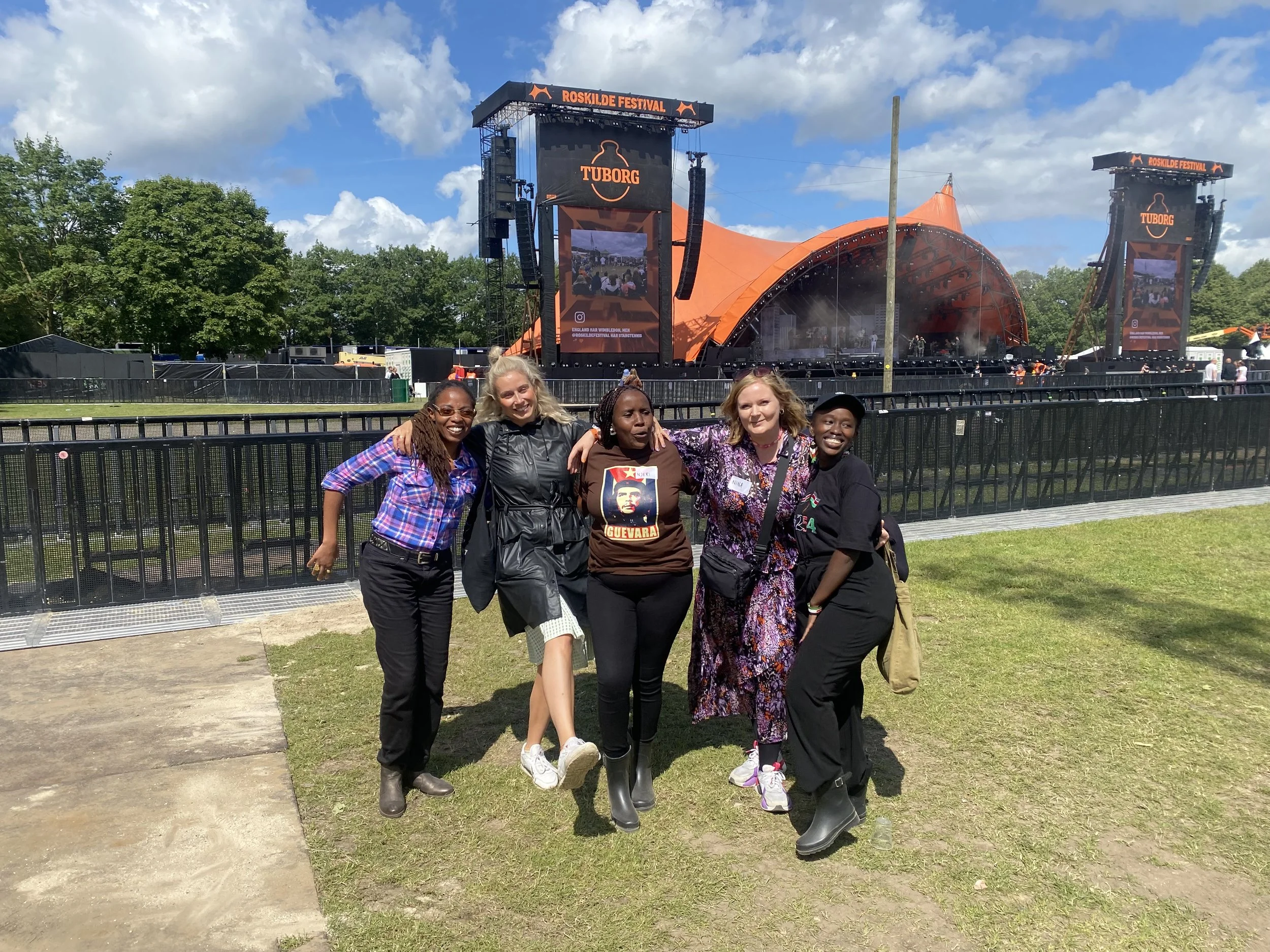
Roskilde Festival 2024, From left: Deborah Wanjugu (PSN, Kenya), Nina Albertsen (Dreamtown), Njery Mwangi (MSJC, Kenya), Nina Ottosen (Dreamtown) & Wanjira Wanjiru (MSJC, Kenya)
At Dreamtown, we recognize storytelling as power. Whoever tells the story has the power to shape reality. The way we narrate people, places, and societies is never neutral — it is political, historically situated, and deeply entangled with global structures of power. As Edward Said wrote:
“Ideas, cultures, and histories cannot seriously be understood or studied without their force, or more precisely their configurations of power, also being studied”, (Said, 1978: 5)
We place our communication and engagement work within a postcolonial and feminist theoretical framework inspired by, among others, Achille Mbembe, Frantz Fanon, Edward Said, Chimamanda Ngozi Adichie, and Jess Crombie.
For us, this means communication is not just about sharing information. It is about responsibility, access, and power. We constantly work on identifying the colonial structures that we, as an NGO, also operate within. We are not perfect. We do make mistakes. The best we can do is listen, ask questions, and dare to critique ourselves and receive criticism, in order to understand the narratives that have structurally shaped our perceptions.
The stories we are told
In 2025, Infomedia and Globalnyt conducted an analysis of Danish media coverage of the world. It closely resembles the way media in other Western countries cover the world. Four percent of international news in Danish media is about the African continent (Globalnyt, 2025) —where nearly 20 percent of the world’s population lives. At the very least, it is worth considering whether it constitutes a democratic challenge that we receive such limited knowledge about such a large share of the world’s population.
We might also ask which stories we are actually hearing within those four percent. It is often about conflict, catastrophe and corruption. The world depicted in this coverage is not representative. It reduces people and parts of the world to stereotypes without agency, rights, or nuances. We have a responsibility to listen to diverse voices and to challenge our own biases. Because telling stories creates power—just as power shapes the stories we tell.
Single stories and stereotypes
Chimamanda Ngozi Adichie warns about stereotypes and what she calls the single story:
“The single story creates stereotypes, and the problem with stereotypes is not that they are untrue, but that they are incomplete. They make one story become the only story”, (TED talk).
When entire continents are framed through one dominant narrative such as crisis, conflict, catastrophe complexity disappears. Philosopher Achille Mbembe has described how Africa is often portrayed as a powerless place trapped in permanent crisis (Mbembe, 2001: 13). These narratives do not just misinform. They have material consequences.
In 2024, Africa No Filter published a report showing that the African continent loses up to 4.2 billion dollars annually in reduced foreign investment and higher interest payments due to media narratives that reproduce stereotypes (Africa Practice, 2024)
Visual appeal and shock value distance us
“When slums are portrayed in a way that focuses on their visual appeal or shock value, the vulnerable poor—who already have few options and limited voices in these processes—can find themselves further disenfranchised. This type of representation can divert attention from the urgent need for meaningful interventions and policy changes to improve their living conditions. This dynamic not only reinforces existing power imbalances but also risks entrenching the stigmatization of slum communities, thereby influencing public perceptions and policy responses in ways harmful to slum residents” (Makanadar & Bandauko, 2024: 4)
Ethical storytelling is the opposite of telling a single story. It points to causes, responsibility, and agency. Financial inequality has been produced by structures — historical decisions, economic systems, and power relations. Poverty is not a natural condition. It is human-made, and therefore it can be changed. Stories can either obscure or expose these structures. When narratives reduce people to passive victims, they create distance rather than understanding.
NGOs and the ethics of representation
Historically, fundraising campaigns and communications made by NGOs have often portrayed white actors as heroes and people of color as helpless victims. Such imagery strip people of dignity and agency. Research shows that these portrayals reinforce stigma and distract attention from structural solutions (Makanadar & Bandauko, 2024: 4).
Alternatives exist. Participatory visual methods such as photovoice allow people to document and represent their own lives, shifting narrative authority back to those who live the story.
The professional storyteller, Jess Crombie, has been co-creating stories and narratives with people, forcibly displaced, from where certain principles of ethical storytelling have emerged. Principles such as mutual respect, trust, collaboration, informed consent, transparency, and ownership of the story. It honors authenticity and complexity rather than reducing people to passive victims. It positions narrators as experts, acknowledges power dynamics and biases, and ensures that narrators and partners have access to their stories (jesscrombieconsultancy.com).
Our position:
At Dreamtown, we work actively to ensure our partners’ voices are raised and heard – both nationally and globally. To ensure that they get the space on the map that actually belongs to them. To make sure their voices are taken into consideration when opinions and policies are shaped. This is done through an approach of co-creations, collaborations, capacity building, and from inviting our partners to take stages in Denmark and tell their stories such as Roskilde Festival and on high schools all over Denmark.
For far too long, stories of black and brown people have been told by white narrators — often for white audiences. To invite our partners to take the stage is not a rhetorical approach. It is an ethical demand.
Only by centering voices of people in marginalized countries and communities, can we actively try to avoid reproducing the stereotypes historically attached to brown and black people by white people. However, we are sure we still do make mistakes. But we practice transparency and accountability as part of the process. We try to challenge our own biases, and we do invite critique from partners, collaborators and our network. Feel free to always e-mail us if you have any considerations, critique points or thoughts about this on dreamtown@dreamtown.ngo
Sources:
Globalnyt: https://globalnyt.dk/udlandsdaekning2025/
Chimamanda Ngozi Adichie: The Danger of a Single Story | TED: https://www.youtube.com/watch?v=D9Ihs241zeg
Africa No Filter: https://resources.africapractice.com/the-cost-of-stereotypes-to-africa
Makanadar & Bandauko, 2024: https://www.sciencedirect.com/science/article/abs/pii/S0016718524002045
Ethical Storytelling: https://www.jesscrombieconsultancy.com/
Fanon, Frantz, 1952: “Black Skin, White Masks”
Mbembe, Achille, 2001: “On the Postcolony”
Said, Edward, 1970: “Orientalism”