A City Is Not Temporary — Dreamtown in Ukraine
It was a strange feeling arriving in a city at war. Lviv’s old town reminded us of other cities like Prague or Budapest. But the sandbags around the statues gave it away, and so did the air-raid alert that sounded on the first night during dinner. This is a city that keeps going despite the shadow of the Russian invasion.
We visited Lviv in April 2026, Jonas and Jakob from Dreamtown, to meet the organizations and people already building the Ukraine that comes after the war.
Before the trip we were asking each other “Will we be in a constant state of alert?” The answer was no. The trams run. The craft beer bars are full. Young people meet outside and laugh. It took us a moment to take all this in. And we know from our partner Molod Online in Zaporizhia that a few hundred kilometers away life in frontline cities can be very different.
Lviv still carries the weight of war as seen by the fact that Lviv’s population has grown from 800,000 to one million since 2022, with 200,000 internally displaced people arriving from cities that were bombed, occupied, or cut off. In our conversations with young Ukrainians, you can sense the more than four years of war has shaped them. They are both deeply affected by it but also ready to channel it into action.
Who We Met and What We Found in Lviv
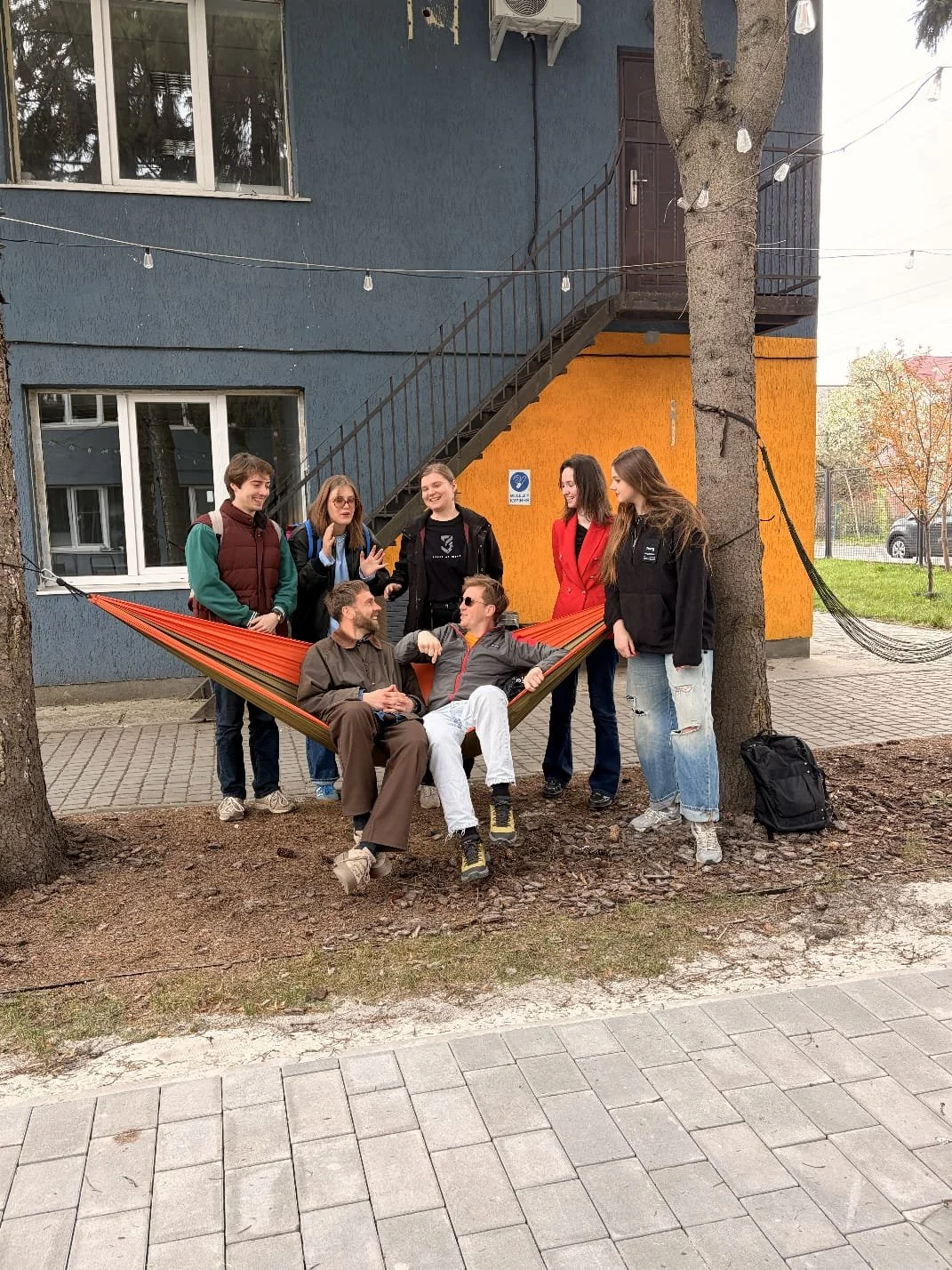
Three members of the Molod Online team travelled from Zaporizhia to join us. We are working together on a project that supports their efforts of working close to the frontline, running civic education, digital platforms, and youth hubs in a city that has been shelled and lost a large share of its pre-war population. They helped us discover and understand better what we were about to see in Lviv.
Our first stop was Tvory, housed in a former kindergarten turned into a shared civic space: studios, meeting rooms, workspace, a cluster of creative and advocacy organisations under one roof. The kind of place that makes democracy feel less like a system and more like a habit. People were just there, working.
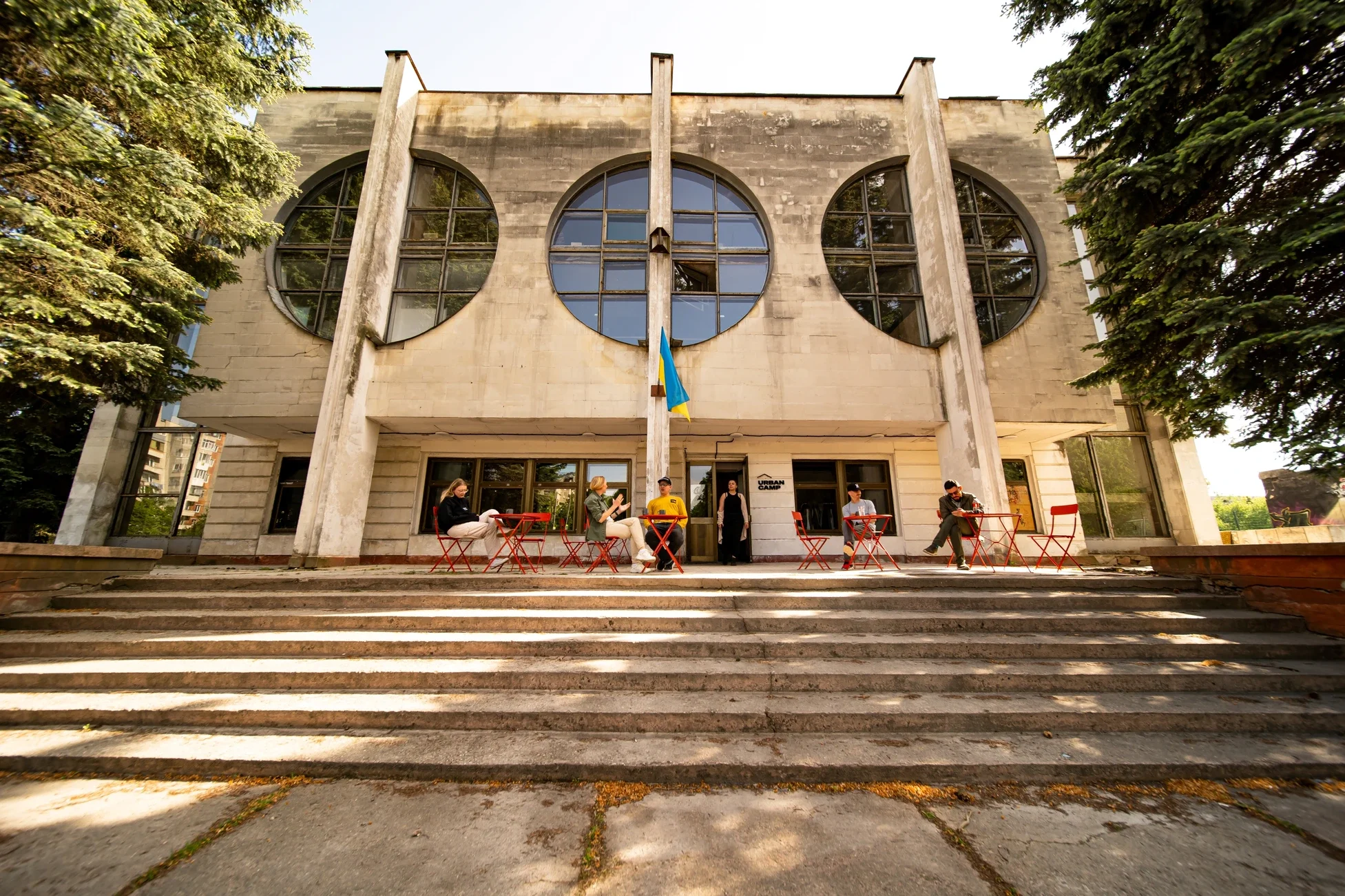
From Tvory, we went to Urban Camp. Young people displaced from Kharkiv who arrived in Lviv had turned an abandoned former Palace of Culture into a giant youth hub and prototype of urban transformation. This Soviet-era brutalist building with vast concrete facades was humming of new life and energy. Skate ramps inside. Graffiti murals on the walls. A basketball hoop where there was once a formal gathering hall. The Ukrainian flag outside.
Urban Camp is proof of what can become of a neglected Palace of Culture now serving hundreds of young people every week, including people, who have been displaced.
Urban Reform, an NGO of city planners and architects present in cities all over Ukraine, has been mapping cultural palaces across Ukraine, identifying over 110 modernist buildings across 80 cities with real regenerative potential. They are working on possibilities of not just restoring them physically, but also restoring what they can mean: spaces that belong to communities, that tell a new story, that say you are welcome here in a country still working out who it wants to be.
In the office of Victor, a youth-leader from the organization Street Culture at Urban Camp, there is a framed portrait of Taras Shevchenko, the nineteenth-century poet who is as close to a founding figure as Ukrainian national identity has. Across our conversations in Lviv, we kept noticing a deep engagement with Ukrainian history, language, and national symbols. War has not just disrupted the lives of young people, it has made them conscious of who they are and what they come from.
One of the Molod Online team put it this way: “It is not before a person stops considering their city temporary that they really start building it.”
On the second day we also visited Jam Factory, a contemporary art museum in a converted industrial building. Through art, it created a space for processing all the difficult feelings that come with resistance: loneliness, shame, and grief. The trauma of war will take as much time to heal if not more as the physical rebuilding of Ukraine.
It was Svitlana from Molod Online who brought it closest home. Her fiancée is serving in the army. Her way of handling it, she said, is to stay in constant motion: running activities, building community, keeping things alive. “When my husband comes home and sees that there is still life, energy and hope, it gives him a reason to keep going.”
Toloka and Hromada
Two Ukrainian concepts stayed with us after the trip. Toloka is an old word for neighbours coming together, without being asked, to help with a task too large for one household. Communal work as a cultural reflex. Since 2022 it has taken on new meaning: millions of Ukrainians organising to do what the state could not do fast enough — supplying soldiers, evacuating civilians, housing the displaced. The NGOs and youth hubs and community kitchens we visited are all expressions of that same instinct.
The hromada is the more formal side of the picture. Since a decentralisation reform in 2015, Ukraine has around 1,400 territorial communities, each with its own elected council, budget, and real authority over local planning and services. Power moved away from Kyiv and toward the places where people live.
Both are needed in the urban rebuild as we saw when we visited Urban Camp where young people simply decided to make something from an abandoned building and later entered into a formal agreement with local hromadas and Lviv City Council.
Building Back Differently
Ukraine’s reconstruction over the next decade is estimated to cost USD 588 billion. That scale comes with pressure toward speed and standardization. Dreamtown has seen in other parts of the world that this can result in cities that function in the narrowest sense, but that young people do not want to stay in and that communities do not feel ownership of.
Ukraine’s reconstruction is a chance to do something different. The country’s architects, planners, and civil society organizations know that restoring social networks and cultural identity alongside physical structures and changing the trail of post-soviet footprints rather than implementing urban planning top-down again, can only happen by putting young people in the room as designers and building local ownership.
What we saw in Lviv shows that the foundations for this already exist. The civil society is strong. Young talent is there. What is needed now is knowledge, relationships, and resources that can scale what already works. That is what Dreamtown is trying to support in Ukraine.
Dreamtown’s Ukraine programme is currently active in Lviv and Zaporizhia, with partners including Urban Reform, Street Culture, and Molod Online. Work on cultural palaces is expanding to further cities across Ukraine.
Photos: Urban Camp Lviv (Street Culture / Dreamtown), Tvory Lviv (Dreamtown), Molod Online youth hub in Zaporizhia (Dreamtown).